Thursday, June 6, 2013

A Wrinkle in Time

1963 Newbery Award
From Barnes and Noble....
Children's Literature
Winner of the Newbery Medal in 1963, L'Engle's work of fantasy and science fiction combined with some Christian theology has now been read by several generations of young enthusiasts. The author went on to write three others, forming a quartet based on the Murry family, and including themes like the power of love and the need to make responsible moral choices. In this story, Meg Murry, her extraordinary little brother Charles Wallace, and schoolmate Calvin O'Keefe make the acquaintance of eccentric Mrs. Whatsit and friends (who turn out to be extraterrestrial beings). Together they journey through a wrinkle in time, a tesseract, to rescue the Murrys' missing father from an evil presence (likened by some interpreters to a black hole), and a sinister brain called IT. Although this is fantasy, the characters are portrayed realistically and sympathetically; it is Meg's ability to love that enables them to return safely to Earth and make secure the right to individuality. L'Engle herself claims that she does not know how she came to write the story; "I had no choice," she says, "It was only after it was written that I realized what some of it meant." A plus with this new edition is an essay by Lisa Sonne that explores scientific concepts related to the story—multiple dimensions, dark energy, and string theory. Each of these concepts were conceived since the book's 1962 publication but are amazingly applicable to A Wrinkle in Time, and help to ensure that this imaginative book will be read for a long time into the future. 2005 (orig. 1962), Laurel Leaf/Random House, Ages 9 up.
—Barbara L. Talcroft
I'm fairly certain that I read this as a child, but really didn't remember it.   I saw it in a book store, so I thought I would read it as part of my endeavor to read as many Newbery books as possible, and I'm glad I did.  I love the idea of space travel!


The Knife of Never Letting Go

From Booklist....


Booklist
Chased by a madman preacher and possibly the rest of his townsfolk as well, young Todd Hewitt flees his settlement on a planet where war with the natives has killed all the women and infected the men with a germ that broadcasts their thoughts aloud for all to hear. This cacophonous thought-cloud is known as Noise and is rendered with startling effectiveness on the page. The first of many secrets is revealed when Todd discovers an unsettling hole in the Noise, and quickly realizes that he lives in a much different world than the one he thought he did. Some of the central conceits of the drama can be hard to swallow, but the pure inventiveness and excitement of the telling more than make up for it. Narrated in a sort of pidgin English with crack dramatic and comic timing by Todd and featuring one of the finest talking-dog characters anywhere, this troubling, unforgettable opener to the Chaos Walking trilogy is a penetrating look at the ways in which we reveal ourselves to one another, and what it takes to be a man in a society gone horribly wrong. The cliffhanger ending is as effective as a shot to the gut.

I really enjoyed this book, especially the dog...interesting concept being able to always hear other's thoughts....
This would be good for the LBJ library.  Can't wait to read the 2nd book in the series.


Feed

2oo2 National Book Award Finalist


KIRKUS REVIEW

“I don’t know when they first had feeds. Like maybe, fifty or a hundred years ago. Before than, they had to use their hands and their eyes. Computers were all outside the body. They carried them around outside of them, in their hands, like if you carried your lungs in a briefcase and opened it to breathe.”
Titus and his friends have grown up on the feed—connected on a 24-hour basis through brain implants to a vast computer network, they have become their medium. “The braggest thing about the feed . . . is that it knows everything you want and hope for, sometimes before you even know what those things are.” Titus is a master at navigating this world where to consume is to live, but when he meets Violet, a distinctly unusual girl whose philology-professor father has chosen to homeschool her instead of sending her to School™, he begins, very tentatively and imperfectly, to question this equation. Thrown together when their feeds are hacked at a party and they are temporarily disconnected, their very hesitant romance is played out against the backdrop of an utterly hedonistic world of trend and acquisition, a world only momentarily disturbed by the news reports of environmental waste and a global alliance of have-not nations against the obliviously consuming US. Anderson (Handel, Who Knew What He Liked, 2001, etc.) has crafted a wickedly clever narrative in which Titus’s voice takes on perfectly the speech patterns of today’s more vapid teens (“ ‘Oh, unit,’ I was like, ‘is this malfunction?’ ”). When Violet’s feed begins to fail, and with it all her life functions, she decides to rebel against all that the feed stands for—the degradation of language, the self-absorption, the leaching of all culture and independent thought from the world—and Titus must make his choice.
The crystalline realization of this wildly dystopic future carries in it obvious and enormous implications for today’s readers—satire at its finest. (Fiction. YA)

This book was a good read, although a little hard to understand with the slang and "degradation of language."


Thursday, May 16, 2013

Dead End in Norvelt

From Publisher's Weekly...
2012 Newbery Award

A bit of autobiography works its way into all of Gantos's work, but he one-ups himself in this wildly entertaining meld of truth and fiction by naming the main character... Jackie Gantos. Like the author, Jackie lives for a time in Norvelt, a real Pennsylvania town created during the Great Depression and based on the socialist idea of community farming. Presumably (hopefully?) the truth mostly ends there, because Jackie's summer of 1962 begins badly: plagued by frequent and explosive nosebleeds, Jackie is assigned to take dictation for the arthritic obituary writer, Miss Volker, and kept alarmingly busy by elderly residents dying in rapid succession. Then the Hells Angels roll in. Gore is a Gantos hallmark but the squeamish are forewarned that Jackie spends much of the book with blood pouring down his face and has a run-in with home cauterization. Gradually, Jackie learns to face death and his fears straight on while absorbing Miss Volker's theories about the importance of knowing history. "The reason you remind yourself of the stupid stuff you've done in the past is so you don't do it again." Memorable in every way. Ages 10–14. (Sept.)

I really enjoyed this book!  I loved Jackie's relationship with Miss Volker and his mother.  Good for middle school.


Tuesday, May 7, 2013

The One and Only Ivan

From Publisher's Weekly...
2013 Newbery Award

Inspired by a true story, Applegate (Home of the Brave) offers a haunting tale told from the perspective of Ivan, a silverback gorilla who has been confined to a small “domain” of concrete, metal, and glass for 27 years. Joining Ivan at the Exit 8 Big Top Mall and Video Arcade are Stella, an aging elephant, and Bob, a feisty stray dog. While other animals perform, Ivan makes art, watches TV, and offers melancholy assessments of their situation. When Ruby, an inquisitive baby elephant, arrives and Stella dies from neglect, her dying wish is for Ivan to help Ruby escape. The brief chapters read like free-verse poetry, the extra line breaks between paragraphs driving home the contrast between Ivan and humans, who in his opinion, “waste words. They toss them like banana peels and leave them to rot.” As is to be expected, there’s significant anthropomorphism, but Applegate is largely successful in creating a protagonist who can understand humans yet feels like a gorilla. Although Ivan’s role in the events leading to their rescue reads as too human, readers will be left rethinking our relationship to animals. 

Adorable book, although a little too young for older middle schoolers.  


Monday, May 6, 2013

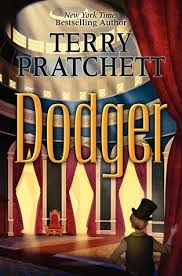
Dodger

From Publisher's Weekly
2013 Printz Honor 

This superb novel from Pratchett is relatively subdued in its humor and contains virtually no fantasy, beyond a flavoring of early Victorian alternate history. It's not only a fine Dickensian novel—Dickens himself figures prominently. It follows a sewer-scouring "tosher" and thief named Dodger, "a skinny young man who moved with the speed of a snake," who, like a knight in soiled armor, leaps out of a drain one night to protect a young woman who is being severely beaten. Two of London's most famous figures, Charles Dickens and social reformer Henry Mayhew, appear on the scene a moment later. A complex plot gradually unravels involving the identity of the mystery girl, known only as Simplicity, and the reasons someone powerful wants her dead. Making guest appearances are such luminaries as Benjamin Disraeli, Queen Victoria, and Angela Burdett-Coutts, the richest woman in the world at the time. Full of eccentric characters and carefully detailed London scenes, the tale embodies both Dickens's love for the common man and a fierce desire for social justice. Ages 13–up. 

I just finished this book,and I thought it was good, although a little difficult to follow because of the complexity of the plot and because it takes place in Victorian England.  It had some funny parts and was really quite clever at times.  


Wednesday, May 1, 2013

Blue Lipstick

From Publisher's Weekly...

A 15-year-old girl named Jessie voices typical—and not so typical—teenage concerns in this unique, hilarious collection of poems. Her musings about trying out new makeup and hairstyles, playing volleyball and cello, and dealing with her annoying younger brother are never boring or predictable. Who else do you know who designs her own clothes and writes poetry to her cat? Jessie’s a girl with strong opinions, and she isn’t shy about sharing them. Her funny, sarcastic take on high school life is revealed through concrete poetry: words, ideas, type, and design that combine to make pictures and patterns. The poems are inventive, irreverent, irresistible, and full of surprises—just like Jessie—and the playful layout and ingenious graphics extend the wry humor.

Sequel to the book in my previous post.  Very humorous and creative.  Loved it!