Thursday, January 21, 2016

Enchanted Air Two Cultures, Two Wings

From Kirkus Review...
2016 Belpre Author Winner

“It really is possible to feel / like two people / at the same time, / when your parents / grandparents / memories / words / come from two / different / worlds.”

Poet and novelist Engle has won a Newbery Honor, the Pura Belpré Award, and the Américas Award, among others. Of Cuban-American descent, she has mostly written about Cuba and Cuban history. This time she brings readers her own childhood. Employing free verse, she narrates growing up in Los Angeles in the 1950s and early ’60s torn by her love of two countries: the United States, where she was born and raised, and Cuba, where her mother was from and where she spent vacations visiting family. Woven into the fabric of her childhood is the anxiety of deteriorating relations between the two countries as the Cuban revolution takes place, affecting both her family and the two countries at large. This is also the time when Engle discovers books and her own poetry as safe places to retreat to. Though it is a very personal story, it is also one that touches on issues affecting so many immigrants, as when she wonders: “Is there any way that two people / from faraway places / can ever really / understand each other’s / daydreams?”
As so many of our children are immigrants or children of immigrants, we need more of these stories, especially when they are as beautifully told as this one. (Cold War timeline, author’s note)(Poetry/memoir. 10 & up)
Beautifully written!  


Tuesday, January 19, 2016

Turning 15 on the Road to Freedom

From Publisher's Weekly
2016 Siebert Finalist

Lowery’s dogged participation as a teen in the fight for equal civil rights—as told to Leacock and Buckley (collaborators on Journeys for Freedom and other titles)—offers a gripping story told in conversational language. “We learned the drill real quick: We went to jail, we came back out, and then we went to jail again.... Pretty soon we knew to take our own little bologna sandwiches... because jail food just wasn’t good.” The matter-of-fact tone often belies the danger Lowery and other protesting teenagers faced. Enhancing the narrative’s appeal are Loughran’s dramatic comics–style illustrations, which accompany archival photos. As the 1965 march to Montgomery drew closer, Lowery found herself in increasingly dangerous situations (e.g., the sweatbox in jail or being tear-gassed). Undeterred by fear, she joined the historic march, offering her description of what it was like as the youngest participant on the wet, four-day journey. In time to mark the march’s 50th anniversary, this recounting informs and inspires. An afterword briefly explains U.S. segregation history and profiles people who lost their lives in connection with the march. Ages 12–up. 

Excellent!  Love the art and the pictures which give it a graphic novel feel.  

The Boys Who Challenged Hitler: Knud Pedersen and the Churchill Club

From Publisher's Weekly…
2016 Siebert Finalist

Hoose (Moonbird) vividly recounts the true story of the courageous and brazen teens who inspired the Danish resistance movement in WWII. Angered and embarrassed by his nation’s lack of opposition to the German invasion, 15-year-old Knud Pedersen, his older brother, and a few classmates formed the secret Churchill Club (named for the British prime minister they admired). For five months in 1942, club members committed daring acts of sabotage, often from their bikes and mostly in broad daylight (“Arson became our game. We took to carrying a small quantity of petrol with us... stuffing the canister in a school bag ”). Hoose’s narrative alternates with Pedersen’s verbatim recollections (taken from a weeklong interview with him in 2012). Though readers initially may have trouble knowing when Pedersen’s quotations end and the author’s segues begin, this gripping story quickly gathers momentum, and the shifts between narrators flow smoothly. Archival photos break up the text, while an epilogue details what happened to each young resister after his imprisonment and the war’s end. A bibliography and source notes conclude this inspiring account. Ages 12–18. 

Excellent!  Reads like a novel.  

Drowned City: Hurricane Katrina and New Orleans

From Publisher's Weekly…
2016 Siebert finalist

Brown follows The Great American Dust Bowl(2013) with the story of the hurricane that destroyed New Orleans. He traces the sequence of events that left the flood levees breached and the city flooded with “a disgusting stew of oil, seawater, feces, rubber tires, foul linen, house paint, shattered lumber, and rot of all kinds.” It’s a grim, heartrending account. Thousands were stranded in venues utterly lacking in supplies or facilities. The crucial question of why the city’s African-American community suffered disproportionately is not dealt with on its face, but Brown’s artwork reflects the city’s diversity, and he recounts the victims’ indignities and outrages with deep sympathy. The author quotes President George W. Bush’s fulsome words for the head of FEMA—“Brownie, you’re doing a heck of a job”—then observes, “The President’s praise confuses many Americans.” Lively, dynamic sketching gives the artwork a sense of urgency and immediacy. It is as important to tell the story of a nation’s failures as it is to record its triumphs, and this is a crucial contribution. Ages 12–up.

Beautifully done!  

Friday, January 15, 2016

The Dinner

From Publisher's Weekly...

This chilling novel starts out as a witty look at contemporary manners in the style of Yasmina Reza’s God of Carnage before turning into a take-no-prisoners psychological thriller. The Lohman brothers, unemployed teacher Paul and politician Serge, a candidate for prime minister, meet at an expensive Amsterdam restaurant, along with their respective spouses, Claire and Babette, to discuss a situation involving their respective 15-year-old sons, Michel and Rick. At first, the two couples discuss such pleasantries as wine and the new Woody Allen film. But during this five-course dinner, from aperitif to digestif, secrets come out that threaten relations between the two families. To say much more would spoil the breathtaking twists and turns of the plot, which slowly strips away layers of civility to expose the primal depths of supposedly model citizens, not to mention one character’s past history of mental illness and violence. With dark humor, Koch dramatizes the lengths to which people will go to preserve a comfortable way of life. Despite a few too-convenient contrivances, this is a cunningly crafted thriller that will never allow you to look at a serviette in the same way again. Agent: Michael Carlisle, Inkwell Management. (Feb.)

Very good, but disturbing!

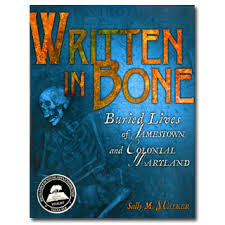
Written in Bone

KIRKUS REVIEW

2010 finalist Excellence in YA Nonfiction


Walker (Secrets of a Civil War Submarine, 2006 Sibert Award) places dedicated young CSI fans right at the elbows of forensic archeologists studying colonial-era burials in the Chesapeake Bay area. Focusing on nine graves, she explains in precise detail how scientists can draw sometimes-surprising conclusions about what these early settlers ate, where they came from and when, their age and sex, how they lived and died—all from subtle clues in the bones, the teeth, the surrounding dirt and, rarely, the sketchy historical evidence that survives. Her examples were all European except for one of African descent and range from a prominent relative of Maryland’s founder ceremoniously interred to a teenager who seems to have been hastily buried in a cellar after being beaten to death. Readers will be enticed by both the scientific detective work and by the tantalizing mysteries that remain. Based on interviews and published sources and profusely illustrated with photos of skulls and skeletons, this makes a riveting companion to Karen Lange’s 1607: A New Look at Jamestown (2007). (maps, timeline, resource lists) (Nonfiction. 12-15)
Fascinating!  

The Green Glass Sea

Scott O'Dell HF Award 2007…
From Publisher's Weekly...

Klages makes an impressive debut with an ambitious, meticulously researched novel set during WWII. Writing from the points of view of two displaced children, she successfully recreates life at Los Alamos Camp, where scientists and mathematicians converge with their families to construct and test the first nuclear bomb. Eleven-year-old Dewey, the daughter of a math professor, is shunned by the other girls at the camp due to her passionate interest in mechanics and her fascination with the dump, which holds all sorts of mechanisms and tools she can use for her projects. Her classmate Suze is also often snubbed and has been nicknamed "Truck" by her classmates (" 'cause she's kind of big and likes to push people around," explains one boy). The two outcasts reluctantly come together when Dewey's father is called away to Washington, D.C., and Dewey temporarily moves in with Suze's family. Although the girls do not get along at first (Suze draws a chalk line in her room to separate their personal spaces), they gradually learn to rely on each other for comfort, support and companionship. Details about the era—popular music, pastimes and products—add authenticity to the story as do brief appearances of some historic figures including Robert Oppenheimer, who breaks the news to Dewey that her father has been killed in a car accident. If the book is a little slow-moving at times, the author provides much insight into the controversies surrounding the making of the bomb and brings to life the tensions of war experienced by adults and children alike. Ages 9-up.

Excellent!  Loved that the book takes place in New Mexico, and the period detail is so interesting!  Also loved that the main character is a science loving young girl!