skip to main |
skip to sidebar
From Publisher's Weekly...
Stonewall Honor 2014
Federle’s hilarious and heartwarming debut novel follows 13-year-old musical theater–loving Nate Foster on his meticulously choreographed overnight getaway to New York City to audition for E.T.: The Musical. Catchy chapter titles framed in marquee lights (“This’ll Be Fast: You Might as Well Meet Dad, Too”) and running gags, like Nate’s use of Broadway flops as epithets (“Moose Murders it all to tarnation!”), add to the theatrical atmosphere as Nate breathlessly narrates his backstory and real-time adventures. Federle (who has himself worked on Broadway) combines high-stakes drama with slapstick comedy as Nate travels by Greyhound bus—dying cellphone and dollars in hand—determined to get to the audition, conceal his lack of chaperone, and compete in the cutthroat world of child actors and stage parents. Nate’s desperation to escape his stifling home environment, instant love affair with the city, questions about his sexuality, and relationship with his dysfunctional but sympathetic family add emotional depth. Federle’s supporting characters affirm theater’s “no small roles” adage, and E.T. references abound—like Elliott’s bicycle in the film, this book soars. Ages 9–13.
Adorable!
From Publisher's Weekly…
2010 Printz Award
Cameron Smith, 16, is slumming through high school, overshadowed by a sister “pre-majoring in perfection,” while working (ineptly) at the Buddha Burger. Then something happens to make him the focus of his family's attention: he contracts mad cow disease. What takes place after he is hospitalized is either that a gorgeous angel persuades him to search for a cure that will also save the world, or that he has a vivid hallucination brought on by the disease. Either way, what readers have is an absurdist comedy in which Cameron, Gonzo (a neurotic dwarf) and Balder (a Norse god cursed to appear as a yard gnome) go on a quixotic road trip during which they learn about string theory, wormholes and true love en route to Disney World. Bray's surreal humor may surprise fans of her historical fantasies about Gemma Doyle, as she trains her satirical eye on modern education, American materialism and religious cults (the smoothie-drinking members of the Church of Everlasting Satisfaction and Snack 'N' Bowl). Offer this to fans of Douglas Adams's Hitchhiker's Guide to the Galaxy seeking more inspired lunacy. Ages 14–up. (Sept.)
I really liked the first part, but the journey just went on and on and on and became very tedious. Definitely too mature for 6th graders!
From Publisher's Weekly….
2010 Schneider Family Book Award
Baskin (All We Know of Love ) steps into the mind of an autistic boy who, while struggling to deal with the “neurotypical” world, finds his voice through his writing ability. Though Jason initially seemed a prodigy, by third grade he had fallen behind academically, and his parents reluctantly had him tested (“A year later the only letters anybody cared about were ASD, NLD, and maybe ADD or ADHD, which I think my mom would have liked better. BLNT. Better luck next time”). Now in sixth grade, Jason still has behavioral difficulties, but is passionate about his writing and actively posts stories in an online forum. There he strikes up a friendship with (and develops a crush on) a fellow writer, though he becomes distraught when he discovers they will both be attending the same writing conference. The first-person narration gives dramatic voice to Jason's inner thoughts about his family and his own insecurities, even as he withholds details (usually about incidents at school) from readers. Jason's powerful and perceptive viewpoint should readily captivate readers and open eyes. Ages 10–14. Mar.)
Good! Easy to read..
From Publisher's Weekly…
Claire’s mother committed suicide, and Claire’s best friend, Richy, went missing nine months ago. Now she and her father have moved from Rhode Island to Amherst, Mass., so Claire can repeat her disrupted senior year in fresh surroundings. Claire’s obsession with her mother and Richy is understandable and clear, more so than her emotions toward the living—namely her father; a college-age student teacher named Tate; and a classmate, Tess—who intrude upon Claire’s self-absorbed consciousness in brief, disconnected scenes. Tate in particular is an uncomfortable character. Because he is a teacher, his interactions and eventual romance with Claire come across as harassing, even stalkerish. Their mutual fascination with the poet Emily Dickinson, symbolized by Tate’s distaste for the way her dress is displayed at the Amherst house where she lived, is the crux of the plot. Burak threads her debut novel with snippets of Dickinson’s poetry, which serve as a springboard for Claire’s own writing, but both Dickinson and Claire are lost amid the thicket of literary allusion and overwrought imagery. Ages 13–up. Agent: Elizabeth Kaplan, Elizabeth Kaplan Literary Agency. (Oct.)
A little hard to follow, but overall a good book.
From Publisher's Weekly…
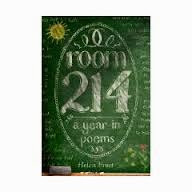
In this collection of brief, deceptively casual poetic monologues, Frost (Keesha's House ) brings to life the voices and spirit of a fifth-grade classroom as she spotlights each member of room 214. Themes such as the disappearance of Jon's bike ("Without my bike, my legs are empty. It/ has tricks you have to know to ride it right") and newcomer Shawna's struggle to fit in are replayed from different viewpoints, allowing readers a glimpse of characters' internal conflicts and relationships. Cast slightly apart from her classmates is artistic Naomi, whose haikus about nature ("What's that squirrel doing?/ Naomi, pay attention! / Nose twitch—tail swish—gone...") provide effective transitions between subjects and moods. Like Naomi, Mrs. Williams, the teacher, remains on the sidelines, wistfully observing her students. While jealousies, rifts and misunderstandings among classmates abound, the fifth-graders' ability to unite is poignantly conveyed after one student's father is killed. In a detailed afterword, Frost explains the exact poetic forms used in each entry (in Part I, anything from sestina to rondelet, in Part II, an acrostic whose "armature" is a phrase uttered by the same speaker in Part I). Readers may be surprised at the complexity of rules governing the writing, so naturally does the author seem to capture the poetic essence of the children's voices—and she makes it look like so much fun that readers may want to try out some of the forms themselves. Ages 10-up. (Apr.)
Very sweet book, but too young for most middle schoolers.
From Publisher's Weekly…
This uncommonly polished debut opens on a riveting scenario: 13 teenagers in a small town have each been designated to listen, in secret, to a box of audiotapes recorded by their classmate Hannah and mailed on the very day she commits suicide. “I'm about to tell you the story of my life,” she says. “More specifically, why my life ended. And if you're listening to these tapes, you're one of the reasons why.” Clay, the narrator, receives the tapes a few weeks after the suicide (each listener must send the box to the next, and Hannah has built in a plan to make sure her posthumous directions are followed), and his initial shock turns to horror as he hears the dead girl implicate his friends and acquaintances in various acts of callousness, cruelty or crime. Asher expertly paces the narrative, splicing Hannah's tale with Clay's mounting anxiety and fear. Just what has he done? Readers won't be able to pull themselves away until that question gets answered—no matter that the premise is contrived and the plot details can be implausible. The author gets all the characters right, from the popular girl who wants to insure her status to the boy who rapes an unconscious girl at a party where the liquor flows too freely, and the veneer of authenticity suffices to hide the story's flaws. Asher knows how to entertain an audience; this book will leave readers eager to see what he does next. Ages 13-up. (Oct.)
Good book, although I thought a part or two implausible, but what do I know about suicide? A little mature for 6th graders!
From Publisher's Weekly…
2014 Caldecott and Siebert Awards
In 1869, not long after the golden spike is driven into the rails at Promontory Summit, a mother and her two children climb aboard the Transcontinental Railroad, leaving behind their old life in Omaha for a new one in California, where Papa awaits. Floca (Moonshot) chronicles their journey from multiple perspectives: documentarian, poet, historian, tour guide, and irrepressible railroad geek. With the rhythmic, verselike text that’s become his signature; expressive typography; and handsome, detailed watercolor, ink, and gouache paintings, he celebrates the majestic (the passing western landscape), the marvelous (the engineering and sheer manpower required to keep the engine safely on its course), and the mundane, from the primitiveness of the toilets to the iffiness of depot food (“If the chicken/ tastes like prairie dog,/ don’t ask why”). It’s a magisterial work (even the endpapers command close reading), but always approachable in its artistry and erudition. And readers will come away understanding that the railroad wasn’t just about getting a group of passengers from Point A to Point B; it carried an entire nation into a new, more rapid world: “Faster, faster, turn the wheels,/ faster, faster breathes the engine!/ The country runs by, the cottonwoods and river./ Westward, westward,/ runs the train,/ through the prairies,/ to the Great Plains,/ on to the frontier.” Ages 4–10. (Sept.)
Beautiful book!