Tuesday, July 19, 2016

The Road from Coorain


From Publisher's Weekly..

At age 11, Conway ( Women Reformers and American Culture ) left the arduous life on her family's sheep farm in the Australian outback for school in war-time Sydney, burdened by an emotionally dependent, recently widowed mother. A lively curiosity and penetrating intellect illuminate this unusually objective account of the author's progress from a solitary childhood--the most appealing part of the narrative--to public achievement as president of Smith College and now professor at MIT. Gifted with an ability to adapt to a wide range of cultures and people and despite ingrained Australian prejudice against intellectuals, Conway devoted herself to the study of history and literature, spurred on by excellent British-style schooling. Her further adventures could easily make a rewarding second volume.

I picked up this book in a used book store in Juneau and thoroughly enjoyed it.  


Monday, July 11, 2016

A Snicker of Magic

From Publisher's Weekly...
2016-2017 NM Land of Enchantment middle school

From every angle, Lloyd’s first novel sparkles and radiates warmth. Felicity Juniper Pickle, 12, feels an immediate kinship with the town of Midnight Gulch, Tenn., the latest place her itinerant mother has brought Felicity, her almost-six-year-old sister, Frannie Jo, and their dog Biscuit. The remote mountain town has a history interwoven with secret magic, but most of it seems to have evaporated years ago following a dual between a pair of famous magician brothers, which divided a family and resulted in a curse. Felicity’s immediate concerns lay with her mother’s sadness and her insistence on constantly uprooting the family. With the help of Felicity’s new friend Jonah, who has his own secret magic that he works on Midnight Gulch; the stories that Felicity collects from various townspeople; and Felicity’s ability to see words that reflect people’s hidden thoughts and desires) she tries to save both the town and her own family. Working in the folksy vein of Ingrid Law’s Savvy, Lloyd offers a reassuring, homespun story about self-expression and the magic that resides in one’s mind and heart. Ages 8–12. 


Sweet story, but Felicity has a lot of understanding, wisdom, and depth of feelings for a 12 year old!


Tuesday, June 28, 2016

The Boy on the Wooden Box


From Publisher's Weekly...
2014 Sydney Taylor honor award for older readers

Leyson, who died in January at age 83, was No. 289 on Schindler’s list and its youngest member. He was just 13 when Leyson’s father convinced Oskar Schindler to let “Little Leyson” (as Schindler knew him) and other family members find refuge in the Emalia factory; Leyson was so small he had to stand on a box to work the machinery. Leyson and his coauthors give this wrenching memoir some literary styling, but the book is at its most powerful when Leyson relays the events in a straightforward manner, as if in a deposition, from the shock of seeing his once-proud father shamed by anti-Semitism to the deprivation that defined his youth. Schindler remains a kindly but enigmatic figure in Leyson’s retelling, occasionally doting but usually distant. Leyson makes it clear that being “Schindler Jews” offered a thread of hope, but it never shielded them from the chaos and evil that surrounded them. Readers will close the book feeling that they have made a genuinely personal connection to this remarkable man. Ages 9–14. 

Beautiful!

Geeks: How Tow Lost Boys Rode the Internet Out of Idaho

From Publisher's Weekly...

While promoting his book Virtuous Reality, journalist Katz was introduced to the world of ""geeks,"" those smart, technically savvy misfits who are ostracized by their high school peers. Katz wrote in his column on the slashdot.org Web site about the isolation, exclusion and maltreatment--from dirty looks to brutal beatings--such kids routinely face. Tens of thousands of anguished e-mails confirmed his story. One of the e-mailers was Jesse Dailey, a working-class 19-year-old trapped in rural Idaho, where he and his friend Eric Twilegar fixed computers for a living, and hacked and surfed the Web, convinced that they were losers and outcasts. Katz, also a writer for Wired and Rolling Stone, traveled to Idaho to meet the pair, intending to chronicle their lives. He wound up encouraging and sometimes assisting Jesse and Eric as they tried to improve their lives by moving to Chicago, where they sought better jobs and even considered applying to college. Sometimes intensely earnest, Katz cuts back and forth between Jesse and Eric's story and more general discussions of the geeks' condition. Over the course of the book, Jesse and Eric come to represent geeks' collective weaknesses and strengths. While the bulk of the book has broad social and educational implications (concerning the fate of bright kids who don't come from socially and educationally privileged backgrounds), it is a highly personal tale: Katz takes us inside the lives of these two young men, shows us their sense of isolation, their complete absorption in the cyberworld, their distrust of authority and institutions, and their attempts to negotiate an often hostile society. He breaks through the stereotype and humanizes this outcast group of young people. (Feb.)

I bought this book for the LBJ library because it is on the list of text exemplars from Common Core Appendix B.  And, it is a very good book, a little wordy and repetitive, but the story is moving.  

Tuesday, June 21, 2016

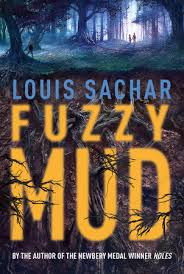
Fuzzy Mud

From Publisher's Weekly...

Sachar blends elements of mystery, suspense, and school-day life into a taut environmental cautionary tale about the insatiable hunger for energy sources and the cost of not doing the right thing. Marshall’s routines at Woodridge Academy—including his daily walk to and from school with his anxious neighbor Tamaya—are upended by the arrival of blowhard bully Chad. A quiet seventh-grader, Marshall becomes a target for Chad, who challenges him to an after-school fight. Rather than suffer a beating, he and Tamaya take a shortcut through the off-limits woods and come across what Tamaya dubs “fuzzy mud,” a strange substance they don’t realize harbors great danger for them and the town at large. Amid chapters following the children’s exploits, Sachar includes transcripts of secret Senate hearings with the scientists who engineered the microorganisms that generate fuzzy mud. In a tense sequence of events, readers learn more about Marshall, Tamaya, Chad, and the peril they face. A dramatic conclusion celebrates the positive ripples of friendship and honesty, and will leave readers with much food for thought. Ages 10–up.

This is a quick and easy read.  It's enjoyable although a little far fetched.  Not nearly as good as Holes.  

Saturday, June 18, 2016

Nest

From Publisher's Weekly...


First-time author Ehrlich’s achingly realistic depiction of family love and loss is set on Cape Cod during the early 1970s. Chirp Orenstein’s mother, Hannah, is a vivacious, talented dancer until a leg ailment forces her to slow down. When Hannah is diagnosed with multiple sclerosis, she falls into a deep depression, fading to an almost unrecognizable shadow of her former self. No one—not Chirp, not her older sister, not their psychiatrist father—can make Hannah feel better. Chirp keeps her sadness and feelings of helplessness to herself except when she’s with her friend Joey, a neighbor who spends a good deal of time trying to avoid his violent father and seems to understand what Chirp is going through. Ehrlich’s novel beautifully captures the fragile bond shared by Chirp and Joey and their growing trust for each other in a world filled with disappointments and misunderstandings. Allusions to songs and trends of the era and references to Chirp’s strong Jewish heritage accentuate and ground the story. Ages 8–12. 

Beautiful...I love how Chirp thinks like someone her age, and not someone wise beyond her years.  


Tuesday, June 14, 2016

The Nest

From Publisher's Weekly...

As four middle-aged Plumb siblings—Leo, Beatrice, Jack, and Melody—await the distribution of the trust fund their father had established for them as just an extra dividend in what he assumed would be their financially comfortable lives, they find themselves in dire economic straits. Unfortunately, the Nest (as they call the trust fund) had been used to settle the medical bills for a young woman who was badly injured when an inebriated Leo crashed his Porsche while they were inside it and getting intimate. Already a sadly dysfunctional family, the siblings plan to confront Leo. In a clever touch that reveals their hopes and desperation, each secretly has a drink in a different Manhattan bar before they convene to hear Leo swear he will get his act together and pay back the money. That Leo can’t be trusted is evident to the reader right away, but his segue into a meaningful domestic relationship with a literary agent seems hopeful. Meanwhile, his siblings try to avoid other financial crises, brought on by their own irresponsible behavior. Jack can’t repay the loans he has kept secret from his husband; Melody won’t be able to meet the mortgage payments on her home or forthcoming college tuition for her twin daughters; Bea has been forced to return the advance on the second novel she cannot write. In her debut, Sweeney spins a fast-moving, often-humorous narrative, and her portrait of each sibling is compassionate even as she reveals their foibles with emotional clarity. She sets scenes among iconic Manhattan watering places, capturing the tempo of various neighborhoods. Her writing is assured, energetic, and adroitly plotted, sweeping the reader along through an engrossing narrative that endears readers to the Plumb family for their essential humanity.

Read this in ebook format while on vacation in Alaska, and I found it very entertaining.